At some point in your chemistry education, you may have been introduced to the song “The Elements,” in which Tom Lehrer does a rapid-fire musical rendition of all the elements' names. Like me, you may even have been offered the opportunity to memorize this song for extra credit. If so, it’s possible that you still remember the names of all the elements, which is an impressive feat—not to mention a fun trick to pull out at parties.
If you’ve memorized the names of the elements, does that mean you’ll never need a periodic table again? Well ... probably not. That’s because the periodic table isn’t just a big bucket that holds all of the elements. Instead, it’s more like a filing system. The position of each element in the table gives important information about its structure, properties, and behavior in chemical reactions. Specifically, an element’s position in the periodic table helps you figure out its electron configuration, how the electrons are organized around the nucleus. Atoms use their electrons to participate in chemical reactions, so knowing an element’s electron configuration allows you to predict its reactivity—whether, and how, it will interact with atoms of other elements.
In this article, we’ll look in more detail at the periodic table, how atoms organize their electrons, and how this allows us to predict the reactivity of elements.
The periodic table
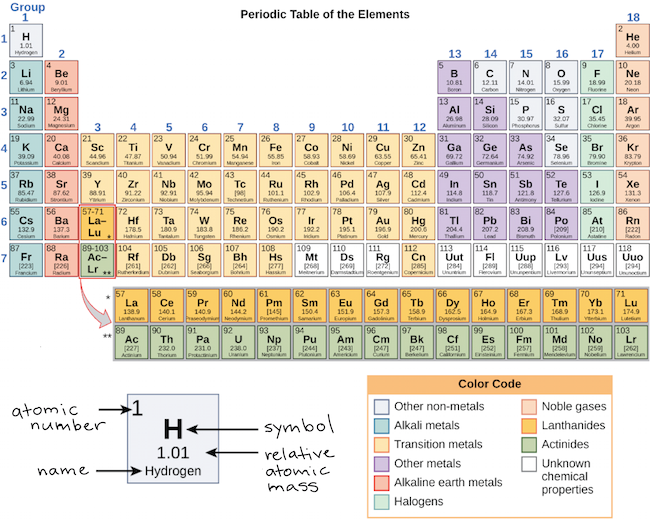
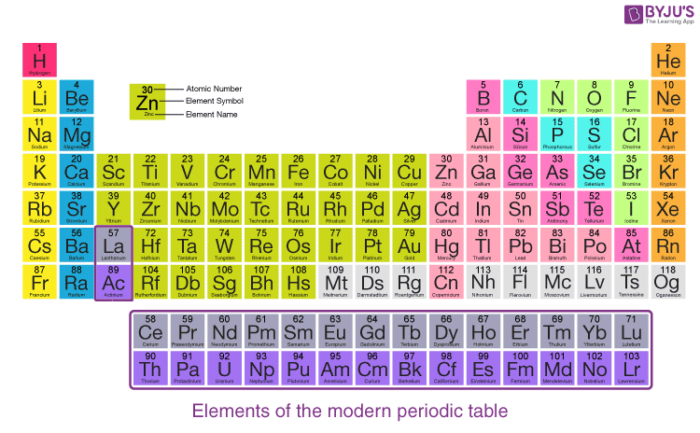
By convention, elements are organized in theperiodic table, a structure that captures important patterns in their behavior. Devised by Russian chemist Dmitri Mendeleev (1834–1907) in 1869, the table places elements into columns—groups—and rows—periods—that share certain properties. These properties determine an element’s physical state at room temperature—gas, solid, or liquid—as well as itschemical reactivity, the ability to form chemical bonds with other atoms.
In addition to listing the atomic number for each element, the periodic table also displays the element’s relative atomic mass, the weighted average for its naturally occurring isotopes on earth. Looking at hydrogen, for example, its symbol,and name appear, as well as its atomic number of one—in the upper left-hand corner—and its relative atomic mass of 1.01.
The periodic table of the elements
Image credit: modified from OpenStax Biology. An accessible version of the periodic table is availablehere.
Differences in chemical reactivity between elements are based on the number and spatial distribution of their electrons. If two atoms have complementary electron patterns, they can react and form a chemical bond, creating a molecule or compound. As we will see below, the periodic table organizes elements in a way that reflects their number and pattern of electrons, which makes it useful for predicting the reactivity of an element: how likely it is to form bonds, and with which other elements.
Electron shells and the Bohr model
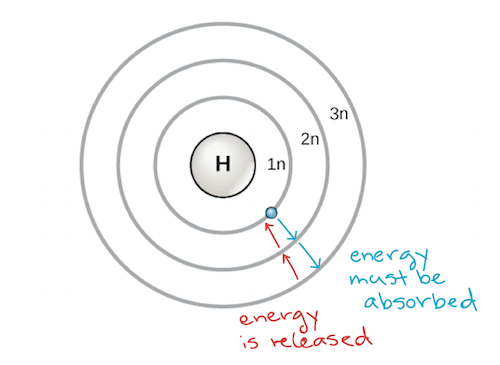
An early model of the atom was developed in 1913 by the Danish scientist Niels Bohr (1885–1962). The Bohr model shows the atom as a central nucleus containing protons and neutrons, with the electrons in circular electron shells at specific distances from the nucleus, similar to planets orbiting around the sun. Each electron shell has a different energy level, with those shells closest to the nucleus being lower in energy than those farther from the nucleus. By convention, each shell is assigned a number and the symbol n—for example, the electron shell closest to the nucleus is called 1n. In order to move between shells, an electron must absorb or release an amount of energy corresponding exactly to the difference in energy between the shells. For instance, if an electron absorbs energy from a photon, it may become excited and move to a higher-energy shell; conversely, when an excited electron drops back down to a lower-energy shell, it will release energy, often in the form of heat.
Bohr model of an atom, showing energy levels as concentric circles surrounding the nucleus. Energy must be added to move an electron outward to a higher energy level, and energy is released when an electron falls down from a higher energy level to a closer-in one.
Image credit: modified from OpenStax Biology
Atoms, like other things governed by the laws of physics, tend to take on the lowest-energy, most stable configuration they can. Thus, the electron shells of an atom are populated from the inside out, with electrons filling up the low-energy shells closer to the nucleus before they move into the higher-energy shells further out. The shell closest to the nucleus, 1n, can hold two electrons, while the next shell, 2n, can hold eight, and the third shell, 3n, can hold up to eighteen.
The number of electrons in the outermost shell of a particular atom determines its reactivity, or tendency to form chemical bonds with other atoms. This outermost shell is known as thevalence shell, and the electrons found in it are calledvalence electrons. In general, atoms are most stable, least reactive, when their outermost electron shell is full. Most of the elements important in biology need eight electrons in their outermost shell in order to be stable, and this rule of thumb is known as theoctet rule. Some atoms can be stable with an octet even though their valence shell is the 3n shell, which can hold up to 18 electrons. We will explore the reason for this when we discuss electron orbitals below.
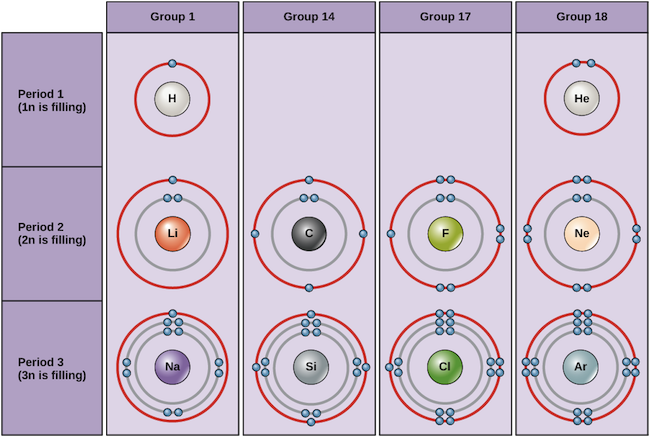
Examples of some neutral atoms and their electron configurations are shown below. In this table, you can see that helium has a full valence shell, with two electrons in its first and only, 1n, shell. Similarly, neon has a complete outer 2n shell containing eight electrons. These electron configurations make helium and neon very stable. Although argon does not technically have a full outer shell, since the 3n shell can hold up to eighteen electrons, it is stable like neon and helium because it has eight electrons in the 3n shell and thus satisfies the octet rule. In contrast, chlorine has only seven electrons in its outermost shell, while sodium has just one. These patterns do not fill the outermost shell or satisfy the octet rule, making chlorine and sodium reactive, eager to gain or lose electrons to reach a more stable configuration.
Bohr diagrams of various elements
Electron configurations and the periodic table
Elements are placed in order on the periodic table based on their atomic number, how many protons they have. In a neutral atom, the number of electrons will equal the number of protons, so we can easily determine electron number from atomic number. In addition, the position of an element in the periodic table—its column, or group, and row, or period—provides useful information about how those electrons are arranged.
If we consider just the first three rows of the table, which include the major elements important to life, each row corresponds to the filling of a different electron shell: helium and hydrogen place their electrons in the 1n shell, while second-row elements like Li start filling the 2n shell, and third-row elements like Na continue with the 3n shell. Similarly, an element’s column number gives information about its number of valence electrons and reactivity. In general, the number of valence electrons is the same within a column and increases from left to right within a row. Group 1 elements have just one valence electron and group 18 elements have eight, except for helium, which has only two electrons total. Thus, group number is a good predictor of how reactive each element will be:
Helium (), neon (), and argon (), as group 18 elements, have outer electron shells that are full or satisfy the octet rule. This makes them highly stable as single atoms. Because of their non-reactivity, they are called theinert gasesornoble gases.
Hydrogen (), lithium (), and sodium (), as group 1 elements, have just one electron in their outermost shells. They are unstable as single atoms, but can become stable by losing or sharing their one valence electron. If these elements fully lose an electron—asandtypically do—they become positively charged ions:and.
Fluorine () and chlorine (), as group 17 elements, have seven electrons in their outermost shells. They tend to achieve a stable octet by taking an electron from other atoms, becoming negatively charged ions:and.
Carbon (), as a group 14 element, has four electrons in its outer shell. Carbon typically shares electrons to achieve a complete valence shell, forming bonds with multiple other atoms.
Thus, the columns of the periodic table reflect the number of electrons found in each element’s valence shell, which in turn determines how the element will react.
Subshells and orbitals
The Bohr model is useful to explain the reactivity and chemical bonding of many elements, but it actually doesn’t give a very accurate description of how electrons are distributed in space around the nucleus. Specifically, electrons don’t really circle the nucleus, but rather spend most of their time in sometimes-complex-shaped regions of space around the nucleus, known aselectron orbitals. We can’t actually know where an electron is at any given moment in time, but we can mathematically determine the volume of space in which it is most likely to be found—say, the volume of space in which it will spend 90% of its time. This high-probability region makes up an orbital, and each orbital can hold up to two electrons.
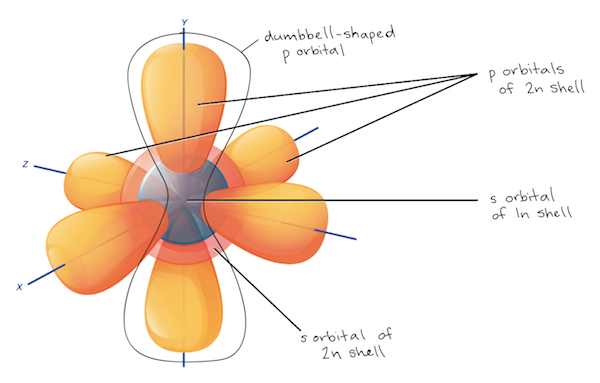
So, how do these mathematically defined orbitals fit in with the electron shells we saw in the Bohr model? We can break each electron shell down into one or more subshells, which are simply sets of one or more orbitals. Subshells are designated by the letters,,, and, and each letter indicates a different shape. For instance,subshells have a single, spherical orbital, whilesubshells contain three dumbbell-shaped orbitals at right angles to each other. Most of organic chemistry—the chemistry of carbon-containing compounds, which are central to biology—involves interactions between electrons inandsubshells, so these are the most important subshell types to be familiar with. However, atoms with many electrons may place some of their electrons inandsubshells. Subshellsandhave more complex shapes and contain five and seven orbitals, respectively.
3D diagram of circular 1s and 2s orbitals and dumbbell-shaped 2p orbitals. There are three 2p orbitals, and they are at right angles to each other.
Image credit: modified from OpenStax Biology
The first electron shell, 1n, corresponds to a singleorbital. Theorbital is the closest orbital to the nucleus, and it fills with electrons first, before any other orbital. Hydrogen has just one electron, so it has a single spot in theorbital occupied. This can be written out in a shorthand form called anelectron configurationas, where the superscripted 1 refers to the one electron in theorbital. Helium has two electrons, so it can completely fill theorbital with its two electrons. This is written out as, referring to the two electrons of helium in theorbital. On the periodic table, hydrogen and helium are the only two elements in the first row, or period, which reflects that they only have electrons in their first shell. Hydrogen and helium are the only two elements that have electrons exclusively in theorbital in their neutral, non-charged, state.
The second electron shell, 2n, contains another sphericalorbital plus three dumbbell-shapedorbitals, each of which can hold two electrons. After theorbital is filled, the second electron shell begins to fill, with electrons going first into theorbital and then into the threeorbitals. Elements in the second row of the periodic table place their electrons in the 2n shell as well as the 1n shell. For instance, lithium () has three electrons: two fill theorbital, and the third is placed in theorbital, giving an electron configuration of. Neon (), on the other hand, has a total of ten electrons: two are in its innermostorbital and eight fill the second shell—two each in theand threeorbitals,. Because its 2n shell is filled, it is energetically stable as a single atom and will rarely form chemical bonds with other atoms.
The third electron shell, 3n, also contains anorbital and threeorbitals, and the third-row elements of the periodic table place their electrons in these orbitals, much as second-row elements do for the 2n shell. The 3n shell also contains aorbital, but this orbital is considerably higher in energy than theandorbitals and does not begin to fill until the fourth row of the periodic table. This is why third-row elements, such as argon, can be stable with just eight valence electrons: theirandsubshells are filled, even though the entire 3n shell is not.
While electron shells and orbitals are closely related, orbitals provide a more accurate picture of the electron configuration of an atom. That’s because orbitals actually specify the shape and position of the regions of space that electrons occupy.
Doberiener’s Triads
The German chemist, Johann Dobereiner in 1800 first observed similarities in the elements on the basis of their properties. He saw that there are groups consisting of three elements (triads) that have similar chemical and physical properties. In every group, the atomic weight of the middle element was half of the sum of the atomic weight of the other two elements. Properties of the middle element were also in the halfway of both the elements. Dobereiner called this grouping method as the law of triads. Later on, it was found that this law was not true for every element and hence it was not successful.
Element
Atomic Weight
Element
Atomic Weight
Element
Atomic Weight
Li
7
Ca
40
Cl
35.5
Na
23
Sr
88
Br
80
K
39
Ba
137
I
127
For example:
Atomic weight of Na
(Atomic weight of Li + Atomic weight of K )/2 = (7+39)/2 =23
Newland’s Octaves
In 1865, after the failure of Doberiener’s triad the English chemist, John Alexander Newlands gave the law of octaves. According to him, elements can be arranged in ascending order of their atomic weights. He also said that in this arrangement every eighth element of a row had similar properties to that of the first element of the same row, depicting the octaves of music. This law was also dismissed as it was only true for elements of up to calcium.
Element
Li
Be
B
C
N
O
F
Atomic weight
7
9
11
12
14
16
19
Element
Na
Mg
Al
Si
P
S
Cl
Atomic weight
23
24
27
29
31
32
35.5
Element
K
Ca
Atomic weight
39
40
Mendeleev’s Periodic Table
The real development in the periodic table took place after the development of Mendeleev’s periodic table. He gave a law which states that “The properties of an element are the periodic function of their atomic masses”. He arranged elements in periods (horizontal rows) and groups (vertical columns) in the increasing order of atomic weights. The vertical column consists of elements that have similar properties.
Limitations of Mendeleev’s Periodic Table
It did not provide a clear idea about the structure of the atom.
In order to arrange elements in a group, the order of atomic weight was reversed several times.
The discovery of new elements and their subsequent addition to the periodic table keeps revealing new dimensions in periodicity. To explore more about the periodic table please visit the BYJU’S YouTube channel.
Metals, Nonmetals, and
Semimetals
The heavy orange zigzag line running diagonally from the upper left to the lower right through groups 13–16 in Figure 2.5.1 divides the elements into metals (in blue, below and to the left of the line) and nonmetals (in bronze, above and to the right of the line). Gold-colored lements that lie along the diagonal line exhibit properties
intermediate
between metals and nonmetals; they are called
semimetals
.
The distinction between metals and nonmetals is one of the most
fundamental
in
chemistry
. Metals—such as copper or gold—are good conductors of electricity and heat; they can be pulled into wires because they are ductile; they can be hammered or pressed into thin sheets or foils because they are malleable; and most have a shiny appearance, so they are
lustrous
. The vast majority of the known elements are metals. Of the metals, only mercury is a liquid at room temperature and pressure; all the rest are solids.
Nonmetals, in contrast, are generally poor conductors of heat and electricity and are not
lustrous
. Nonmetals can be gases (such as chlorine), liquids (such as bromine), or solids (such as iodine) at room temperature and pressure. Most solid nonmetals are brittle, so they break into small pieces when hit with a hammer or pulled into a wire. As expected,
semimetals
exhibit properties
intermediate
between metals and nonmetals.
Group 1: The Alkali Metals
The alkali metals are lithium, sodium, potassium, rubidium, cesium, and francium. Hydrogen is unique in that it is generally placed in Group 1, but it is not a metal. The compounds of the alkali metals are common in nature and daily life. One example is table
salt
(sodium chloride); lithium compounds are used in greases, in batteries, and as drugs to treat patients who exhibit manic-depressive, or bipolar, behavior. Although lithium, rubidium, and cesium are relatively rare in nature, and francium is so unstable and highly radioactive that it exists in only trace amounts, sodium and potassium are the seventh and eighth most abundant elements in Earth’s crust, respectively.
Group 2: The Alkaline Earth Metals
The alkaline earth metals are beryllium, magnesium, calcium, strontium, barium, and radium. Beryllium, strontium, and barium are rare, and radium is unstable and highly radioactive. In contrast, calcium and magnesium are the fifth and sixth most abundant elements on Earth, respectively; they are found in huge deposits of limestone and other minerals.
Group 17: The Halogens
The halogens are fluorine, chlorine, bromine, iodine, and astatine. The name halogen is derived from the Greek words for “
salt
forming,” which reflects that all the halogens react readily with metals to form compounds, such as sodium chloride and calcium chloride (used in some areas as road
salt
).
Compounds that contain the fluoride ion are added to toothpaste and the water supply to prevent dental cavities. Fluorine is also found in Teflon coatings on kitchen utensils. Although chlorofluorocarbon propellants and refrigerants are believed to lead to the depletion of Earth’s
ozone layer
and contain both fluorine and chlorine, the latter is responsible for the adverse effect on the
ozone layer
. Bromine and iodine are less abundant than chlorine, and astatine is so radioactive that it exists in only negligible amounts in nature.
Group 18: The
Noble Gases
The
noble gases
are helium, neon, argon, krypton, xenon, and radon. Because the
noble gases
are composed of only single
atoms
, they are called
monatomic
. At room temperature and pressure, they are unreactive gases. Because of their lack of reactivity, for many years they were called inert gases or rare gases. However, the first chemical compounds containing the
noble gases
were prepared in 1962. Although the
noble gases
are relatively minor constituents of the atmosphere, natural gas contains substantial amounts of helium. Because of its low reactivity, argon is often used as an unreactive (inert) atmosphere for welding and in light bulbs. The red light emitted by neon in a gas discharge tube is used in neon lights.
The
noble gases
are unreactive at room temperature and pressure.
Explanation for periodic properties
The periodic properties of an element depend on valency and number of shells in an atom. As we move down a group the number of shell increases successively such that the number of the shell of an element is equal to the number of periods to which it belongs. As we move across a period, the number of shell remains the same. For example, elements of the second period have two shells.
The combining capacity of an atom is known as its valency. It is equal to the number of electrons that an atom can accept or donate in order to complete its octet. As we move down a group, the number of electrons in the valence shell remains the same. Hence, the valency of a group is constant. Valency depends on the number of electrons in the outermost shell of an atom. If the number of electrons is 1, 2, 3, 4 then the respective valences will be 1, 2, 3, 4. If the number of electrons in the outermost shell will be 5, 6, 7 then the valency will be 8 – 5 = 3, 8 – 6 = 2 and 8 – 7 = 1. Valency is the combining capacity of an atom hence will always have a positive value and largely affects the periodic properties.
In a period, the number of electrons increases from left to right. As a result, the number of electrons needed to complete the octet also changes. Hence, the valency successively increases to four in group 14 and then subsequently decreases to 1 in group 17.
Modern Periodic Table:
A tabular arrangement of elements in groups and periods which highlights the regular trends in properties of elements is defined as the periodic table.
Features of Modern Periodic Table
There are eighteen vertical columns known as groups in the modern periodic table which are arranged from left to right and seven horizontal rows which are known as periods.
Group number
Group name
Property
Group 1 or IA
Alkali metals
They form strong alkalis with water
Group 2 or IIA
Alkaline earth metals
They also form alkalis but weaker than group 1 elements
Group 13 or IIIA
Boron family
Boron is the first member of this family
Group 14 or IVA
Carbon family
Carbon is the first member of this family
Group 15 or VA
Nitrogen family
This group has non-metals and metalloids
Group 16 or VIA
Oxygen family
They are also known as chalcogens
Group 17 or VIIA
Halogen family
The elements of this group form salts.
Group 18
Zero group
They are noble gases and under normal conditions they are inert.
Summary
The
periodic table
is used as a predictive tool. It arranges of the elements in order of increasing atomic number. Elements that exhibit similar
chemistry
appear in vertical columns called groups (numbered 1–18 from left to right); the seven horizontal rows are called periods. Some of the groups have widely-used common names, including the alkali metals (Group 1) and the alkaline earth metals (Group 2) on the far left, and the halogens (Group 17) and the
noble gases
(Group 18) on the far right. The elements can be broadly divided into metals, nonmetals, and
semimetals
.
Semimetals
exhibit properties
intermediate
between those of metals and nonmetals. Metals are located on the left of the
periodic table
, and nonmetals are located on the upper right. They are separated by a diagonal band of
semimetals
. Metals are
lustrous
, good conductors of electricity, and readily shaped (they are ductile and malleable), whereas solid nonmetals are generally brittle and poor electrical conductors. Other important groupings of elements in the
^An element zero (i.e. a substance composed purely of neutrons), is included in a few alternate presentations, for example, in the Chemical Galaxy. See Labarca, M. (2016). "An element of atomic number zero?". New Journal of Chemistry. 40 (11): 9002–9006. doi:10.1039/C6NJ02076C.
^ Jump up to:abEmsley, John (2011). Nature's Building Blocks: An A-Z guide to the elements (New ed.). New York, NY: Oxford University Press. ISBN978-0-19-960563-7.


Nice
ReplyDeleteVery Nice information
ReplyDelete